
Reframing the Rental
Exploring various furniture designs and augmenting the dated layouts of a fixed living space.
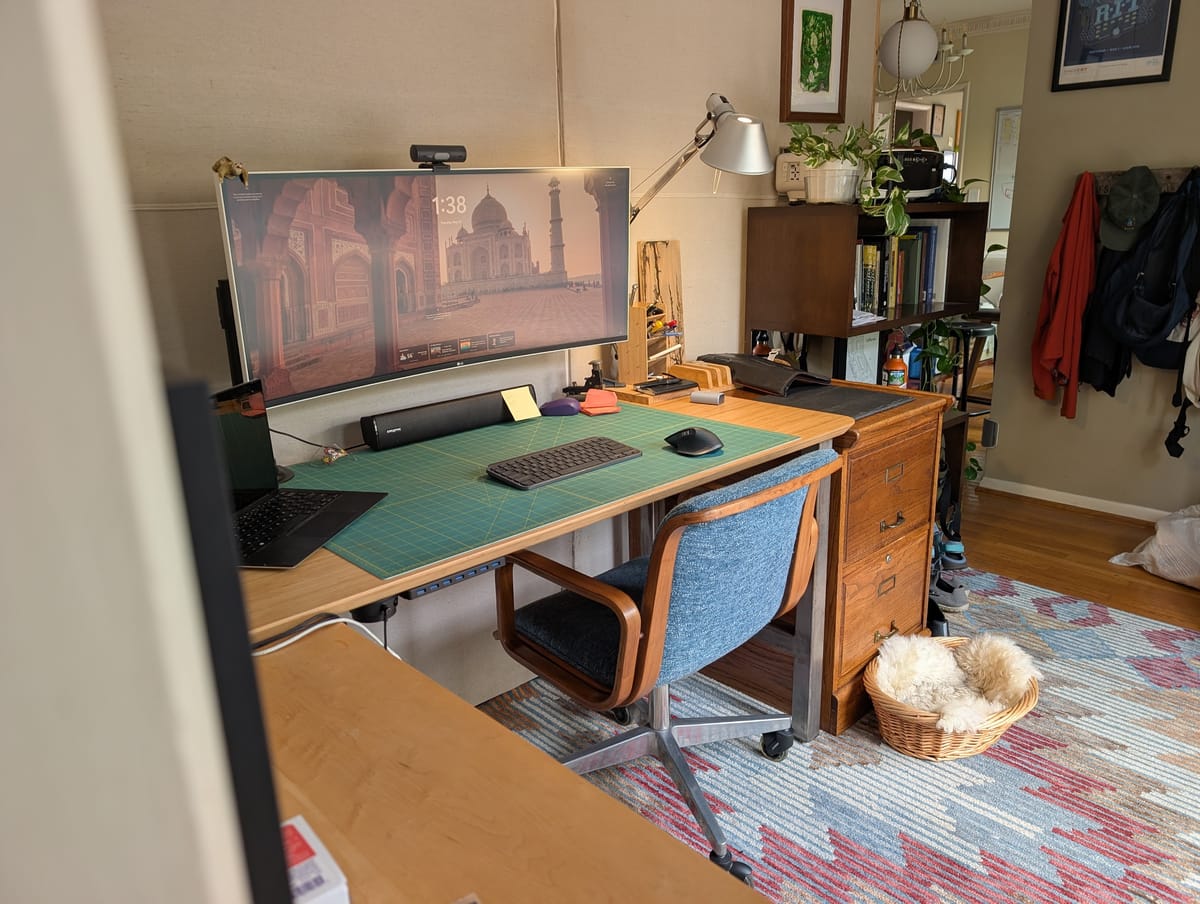
Renting is an exercise in compromise. My experience as a (thusfar life-long) renter has been a repeating story of moving to a spot, then making do with the mix of styles, paint colors, and a living spaces. Finding furniture that fits the rooms you have, squeezing out utility, and cautiously dancing around appliances, fixtures, and even drywall that you have no authority to adjust or tamper with. This dance took a twist in 2021 when I moved to our shared house in Los Angeles, where the majority of non-condo housing was & is designed for the home-owning, nuclear family, not multiple young couples eeking out existence in the vestiges of the American dream. Properties were built with very little foresight into the flexibility a post-capitalist economic system would require from its housing stock.
Us renters may make efforts to hide these constraints, seeking the gentle embrace of the our Blue and Yellow and Purple saviors , or the wilds of used furniture markets to mask the oversights made of the builders of our places. We place carpets on top of worn flooring, wall decor and tall furniture in front of broken plaster , curtains over hallways and doorways to repurpose them as closets - for me, these attempts to customize have felt like a fragile veneer of comfort & stability. And when we move to escape that incessant rent increase or chase that demanding career path, they almost always become another component of the 10 Tons of plastic-containing garbage furniture Americans generate annually.
The 50s-era craftsman I inhabit with several housemates was maybe a perfect three-bed with a den or office when it was built, but today it is rented to its max, and it provided very little accomodation for the use it was recieving. Notably:
- With all rooms used as bedrooms, we either worked from our duvets (not always bad - I'm writing this from it now!) or huddled around the kitchen table. There aren't many 9-5 commutes in our sedans and station wagons to the downtown core in a world where working freelance, remote, or gig jobs are the primary path to financial stability.
- The annex-style kitchen is quaint and well suited for one busy homemaker, but becomes remarkably similar to the 10-lane 405 expressway a few blocks from us when two, let alone five folks try to cook dinner simultaneously.
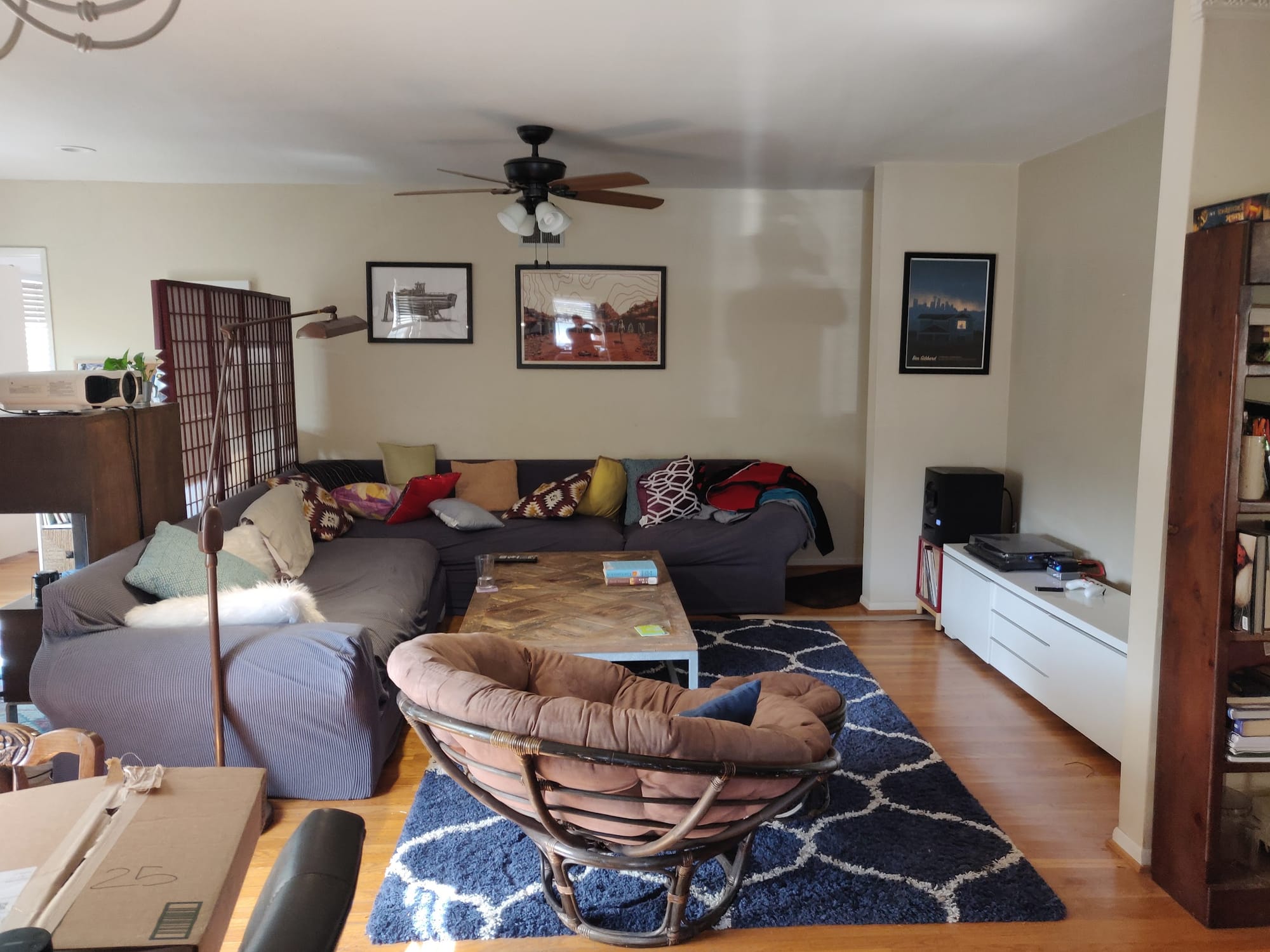
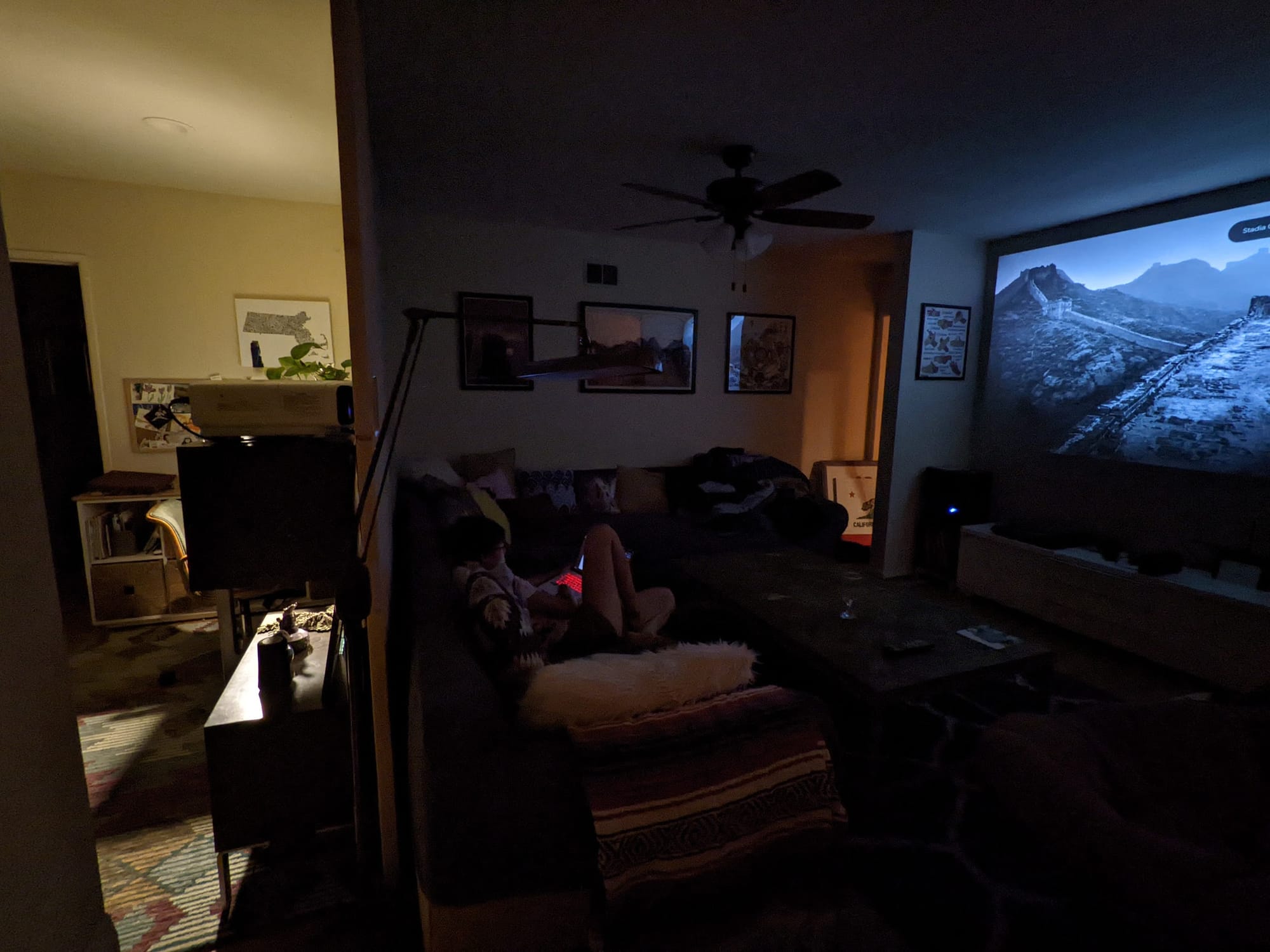
When I moved here I set my desk in the back of our livingroom, but with no privacy or soundproofing it was not a comfortable or effective place to hold a work call, or not get sucked into the household debate over the latest Sportsball thing. A scavenged room divider was my cheap attempt at separation; this did nothing but visually split the space, and with a major gap between its top and our ceilings and its translucent insides, it did a poor job at that as well. Pairing this divider with our use of a projector meant that movies and TV were dulled by my desk lamp, and my work was always backlit by the content housemates and friends were trying to enjoy.
Circular Dreams
Recycling of municipal solid waste (MSW) is quite poor in the US - the most recycled material is paper, and of this only 62% is recovered from waste streams as of 20181. Glass, Aluminum, wood, and plastics are the least recycled, with over 3/4 of items being chucked going to landfill.
Furniture is a major contributor to the trash pile, as almost all furniture is a complex composite of metals, plastics, and wood. Composites that were designed for assembly, with no considerations given to End of Life (EOL) are nigh impossible to separate2. That nice dresser you got for a year and chucked when you moved was likely either made of plywood or some type of fiberboard - regardless, a mix of plastic resin and wood which cannot be made into something else, and will not fully biodegrade. It then was likely coated in either a plastic paint or plastic veneer, and metal fasteners were used to hold it all together.
Sources:
After deliberating between some pricey off-the-shelf concepts and used office cubicle walls from offices in their post-pandemic downsizing, I decided to take a crack at a new lemonade recipe with this small pile of lemons, and make a better room divider. I set aside a few goals for my creation:
- No Plastics. Like, as close to zero as possible. Natural materials can be decomposed by microbes that aren't genetically-engineered biohazards, and metals can be used again. Plastics are going to be our next potential downfall after climate change, and I'm not putting more of that blood on my own hands.
- It fits, really well. Whatever solution I come up with should be one I won't be disappointed with in time. commodity rental furniture typically makes little consideration that any part of a home has a custom use, even if it's not a custom thing itself. This is custom, so it better buck that trend.
- Function and form. Lets no light through, and ideally also blocks some sound.
- Impact-free disposal. This thing turns to dirt when we no longer need it. Goal 1 plays a major factor here, but there's also the consideration of cost and physical volume:
- I don't want to spend more than $100 on something disposable
- the disposed solution should be something physically and ecologically compatible with residential trash/recycling.
Originally I assumed I would build walls as they are done in an actual house - gypsum board and 2x4 lumber. But after a few weight and cost calculations, I found the price would be hard to justify, and the weight load on my floor would be enough to warrant some sort of assessment I had no confidence in getting or making myself. Fabric walls (like those in an office cubicle) became my next source of inspiration, and the source of my final design.
I quickly recognized that a wall being close to the right dimensions would never work well for room dividing - walls needed to be completely enclosing to have soundproofing abilities (case in point: soundproofing walls along highways are only slightly effective at reducing road noise. Ask me how I know). Office liquidation miracles on Craigslist would not suffice - This would need to fit like a glove. While muslin and canvas fabrics seemed appropriate, I found their costs a bit too high, and instead settled on repurposing a canvas painting cloth, available from Harbor Freight for $10 (now $11). I identified fabrics as not only a great wall cover material, but also a great option for sound insulation - with wools and burlap being great natural options. I eventually settled for cost reasons on a close analogue - Uhaul moving pads (which are made from recycled and shredded denim, aka woven cotton).
The frames were sized to be a tad too short - rather than screwing or gluing them to the wall and ceiling, I intended to use friction to keep them in place, relying on screw feet and felt strips to wedge the wall between ceiling and floor. This would add some compliance to shifting of the home, and double as a way to mask any out of square interfaces . Because I'm stubborn and crafty, I designed in a small opening for our projector to pass through - due to the specifics of our living room, having things set up this way made the most sense (and who doesn't want a secret movie projector in their wall?).
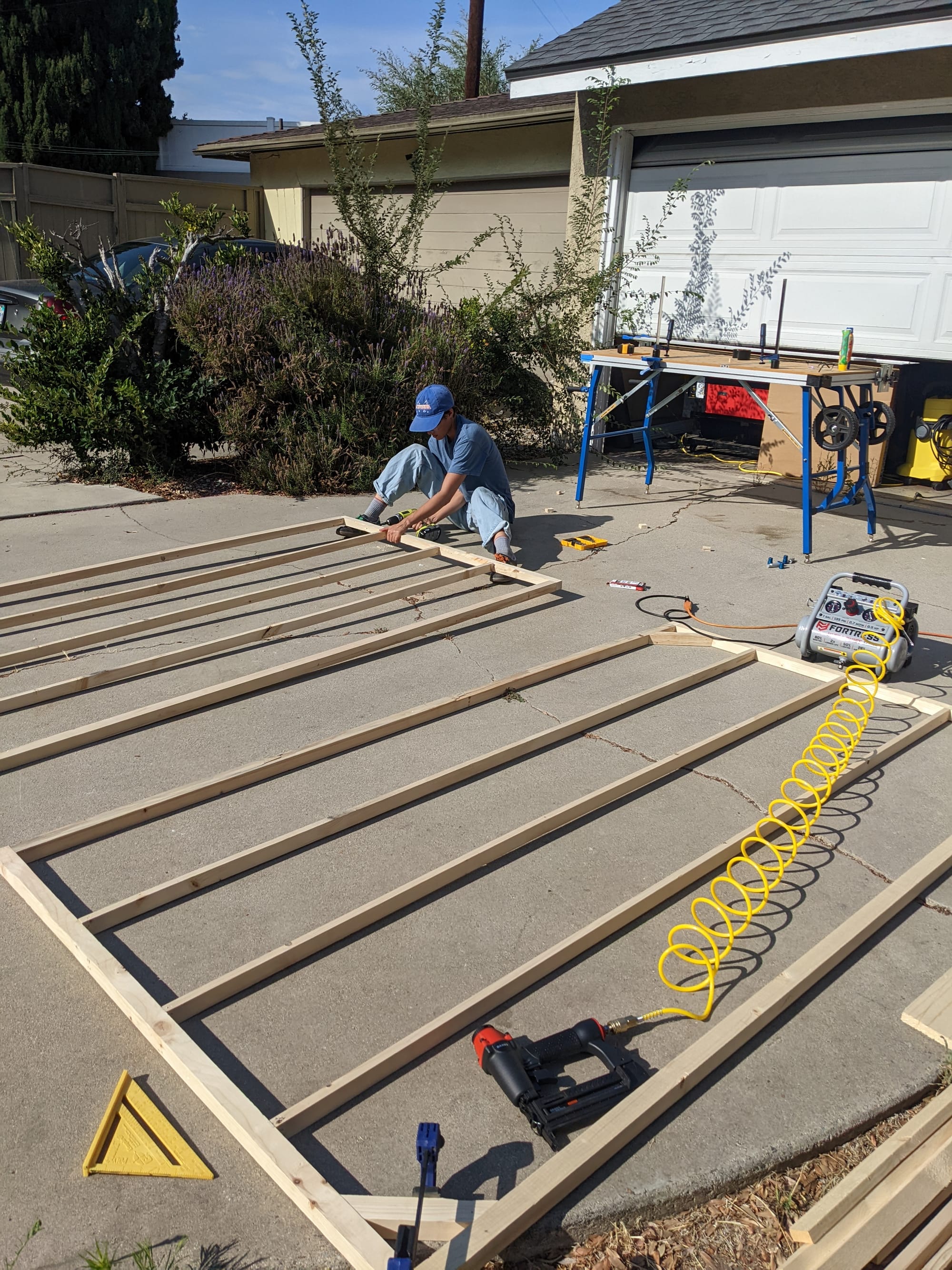
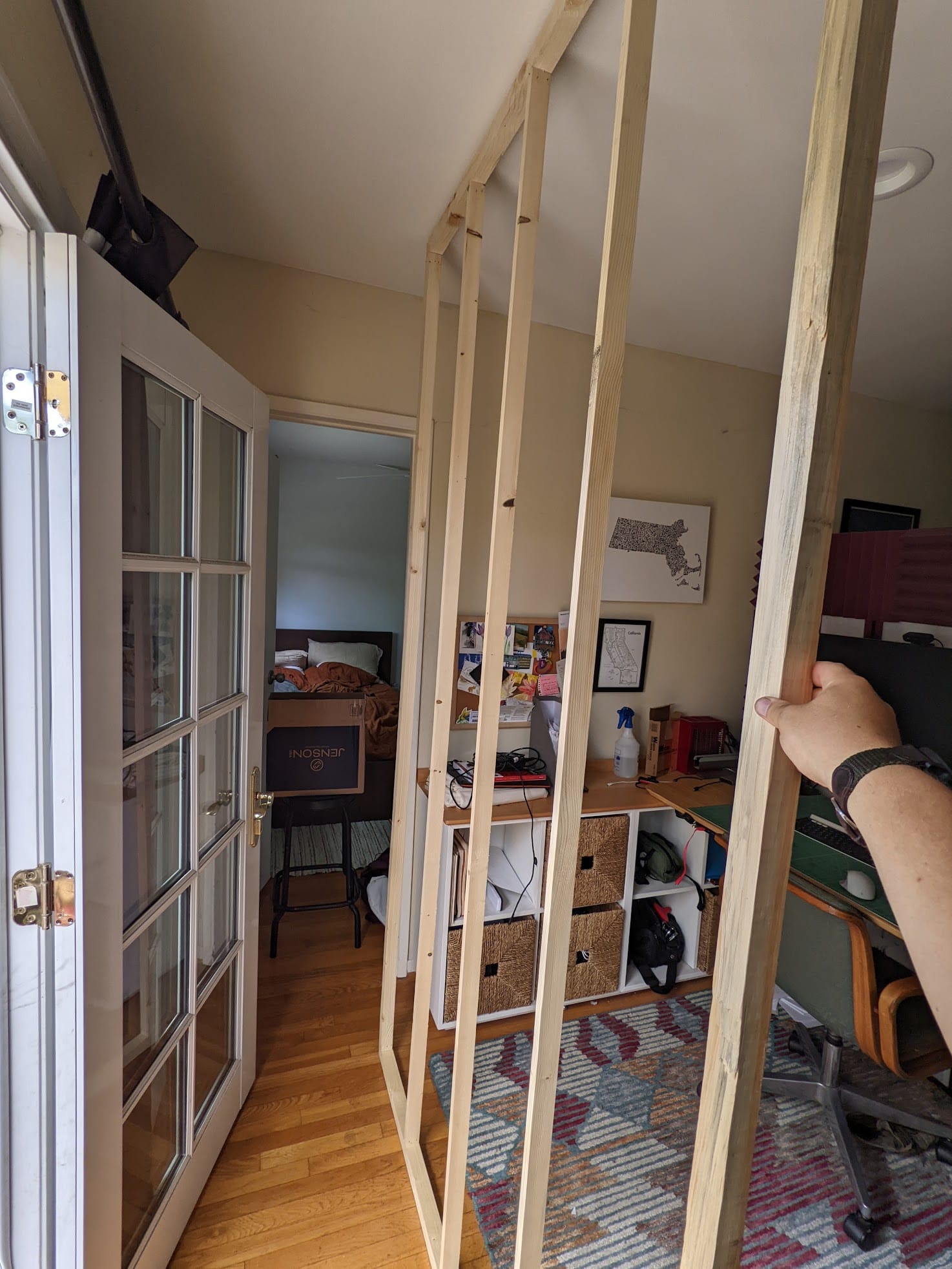
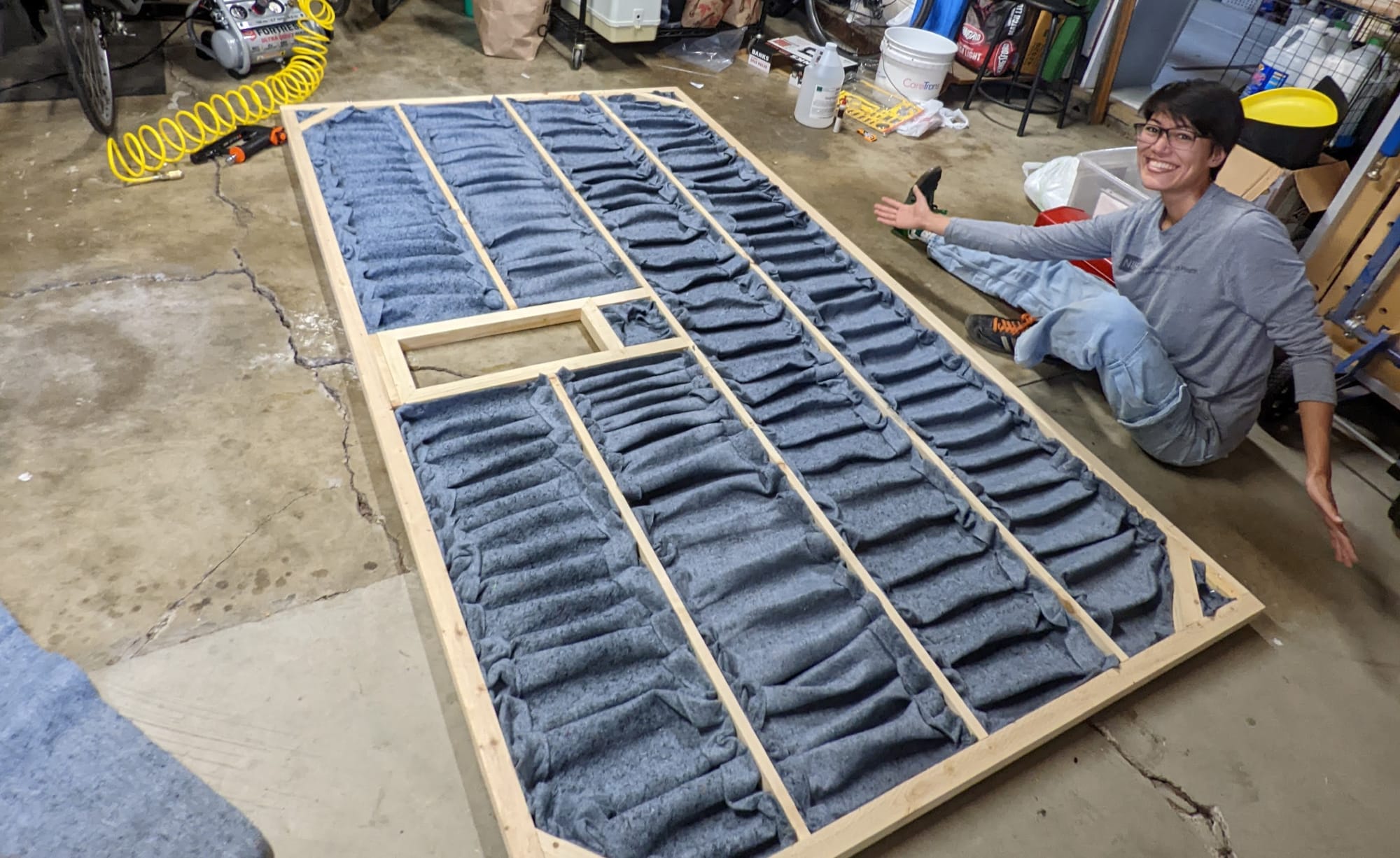
We took advantage of a bountiful driveway to assemble the two frames using a Brad Nailer and wood glue. We then installed the sound insulation, electing to ruffle them inside the wall cavity to both make installation easier, and increase the internal surface area (more sound bounces = more isolation). This made flattening the material a bit harder but was worth the extra work and staples.
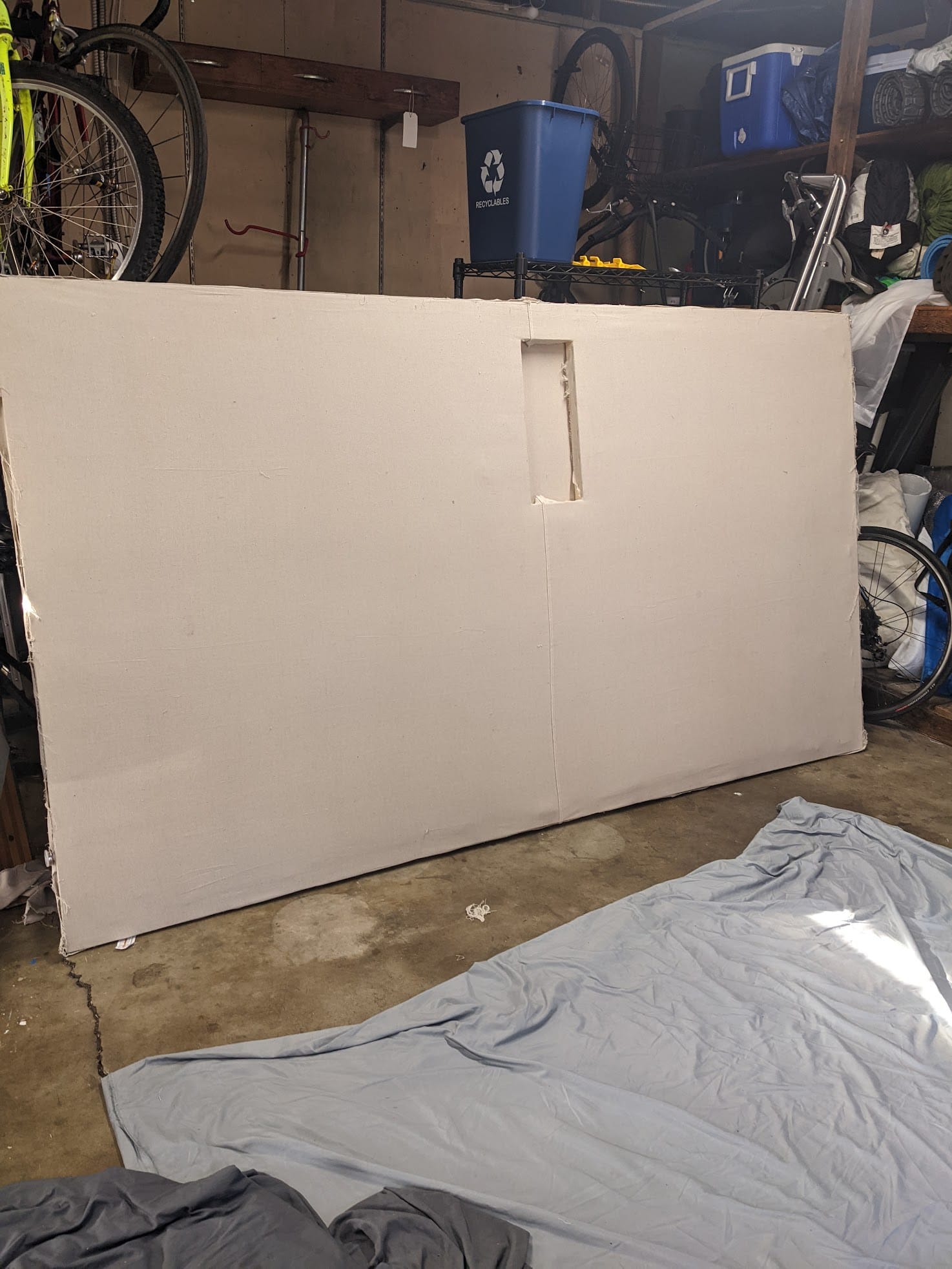
Fabric was stretched across the baffled (I was too, at first) frame in the same manner as an art canvas. This proved surprisingly easy and I had no wrinkles on any of the attempts (ironing the canvas beforehand helped, as well). The biggest challenges here were making sure the fabric was aligned with the frame, and reaching all four sides for consistent stapling. We initially covered the projector window completely, later slicing through it and performing the same stretching technique (but inverted) to pull it tight around the inset frame. We lined the frame on the outside with a finished piece of pine to hide all of the staples and provide protection to the fabric edge.
A note on Tooling
This pneumatic stapler is a favorite of Adam Savage, and also now a favorite of mine. It saved huge amounts of time and hand fatigue on this project, and probably made the finished product as slick as it is.

We had surprisingly few issues or challenges with this build, and my partner and I were able to go from ideas to complete walls in a single weekend - probably something like 12 hours total of work. Other notable successes:
The cost of materials did stay around $100, exceeded by the cost of a small air compressor (hey, I was going to get one anyways)
The only plastics in the construction are:
- two strips of foam to block a bit of light sneaking between my (very straight) walls and the (not so straight) wall of our livingroom.
- nylon pads on the adjustable screw feet
- small bits of wood glue on the frames
I can measure about a 5-7 dB drop between the desk and the couch!
While we have definitely not thrown this thing away yet, the lightweight lumber and fasteners and the fact that so much of this wall is just air, means it will someday fit into a residential trash bin. a Handsaw or just some strong hands can break apart the slim bits of wood used for the frames.
As an example, the average human spends about an hour and a half of their day on social media - which to me, doesn't sound like a ton! But stretched out, that's 10% of their waking life - about 7-8 years.
It applies to productive time uses as well - if I'd written two words of this article per day, I could have published it in September 2025!
If I were to make this again, there are a few things I'd do differently:
- Adding in the sound insulation in controlled ruffles was time -consuming , but I think the damping is mostly due to the material just being in there. Reducing the "neatness" without impacting the ouside fabric would accomplish the same performance with fewer metal bits introduced. I've also since discovered purpose-built wall insulation made with recycled denim, which is great to see!
- This wall is not very fireproof; canvas and denim are both made from cotton fibers and are solidly flammable. There are common fireproofing methods for these materials, like Borax solution sprays, and more exotic solutions which have been researched. I'd like to incorporate these into the wall to help it act like a real wall in the event of a fire.
- My walls happened to match the light eggshell of the painter's cloth, but what if my walls were a different color? This is possible with dyed or bleached fabrics, but I wonder if there's an easier way...
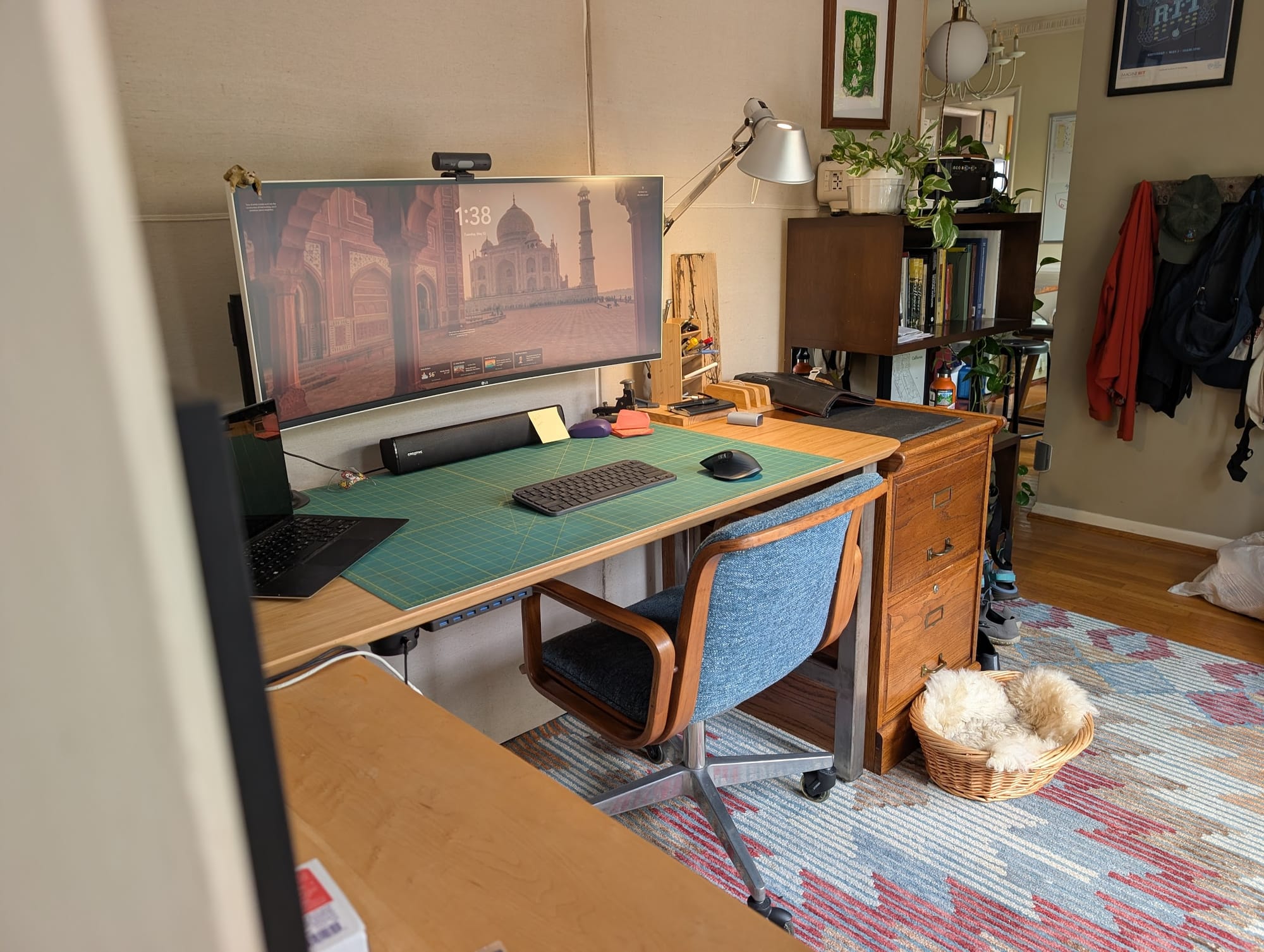

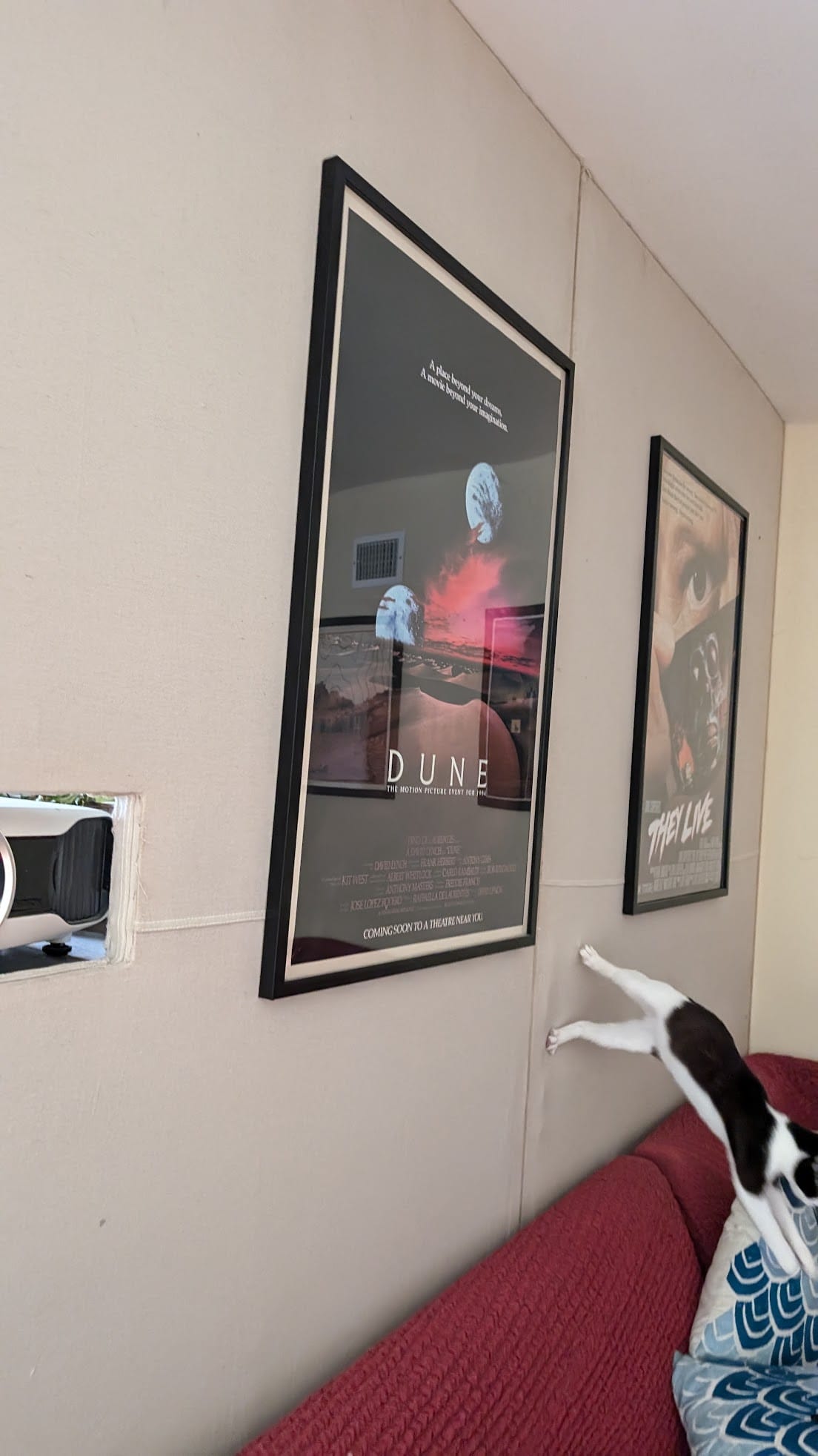
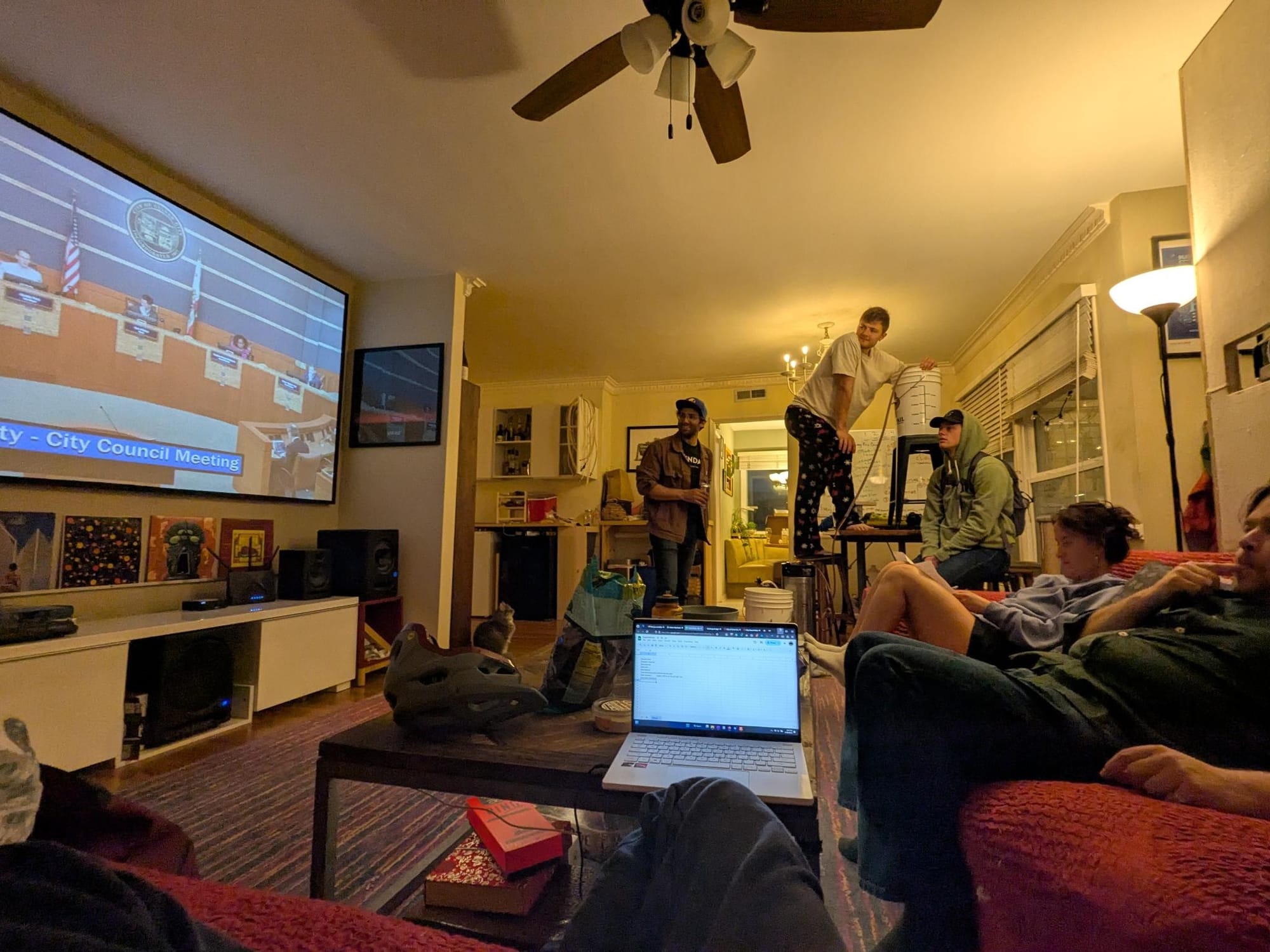
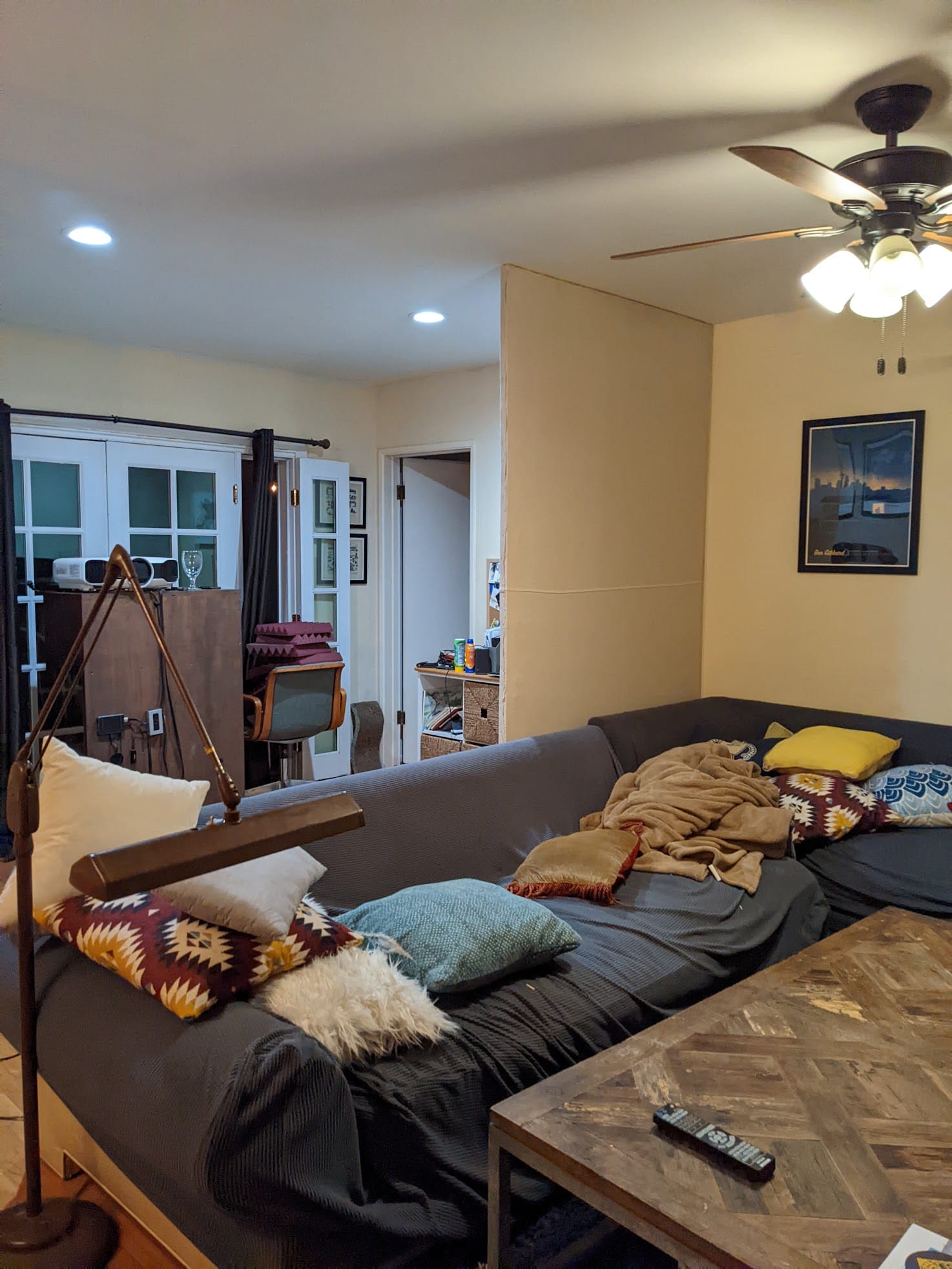
I don't usually take pictures of walls, but here are some candid shots from home life that happen to include it!
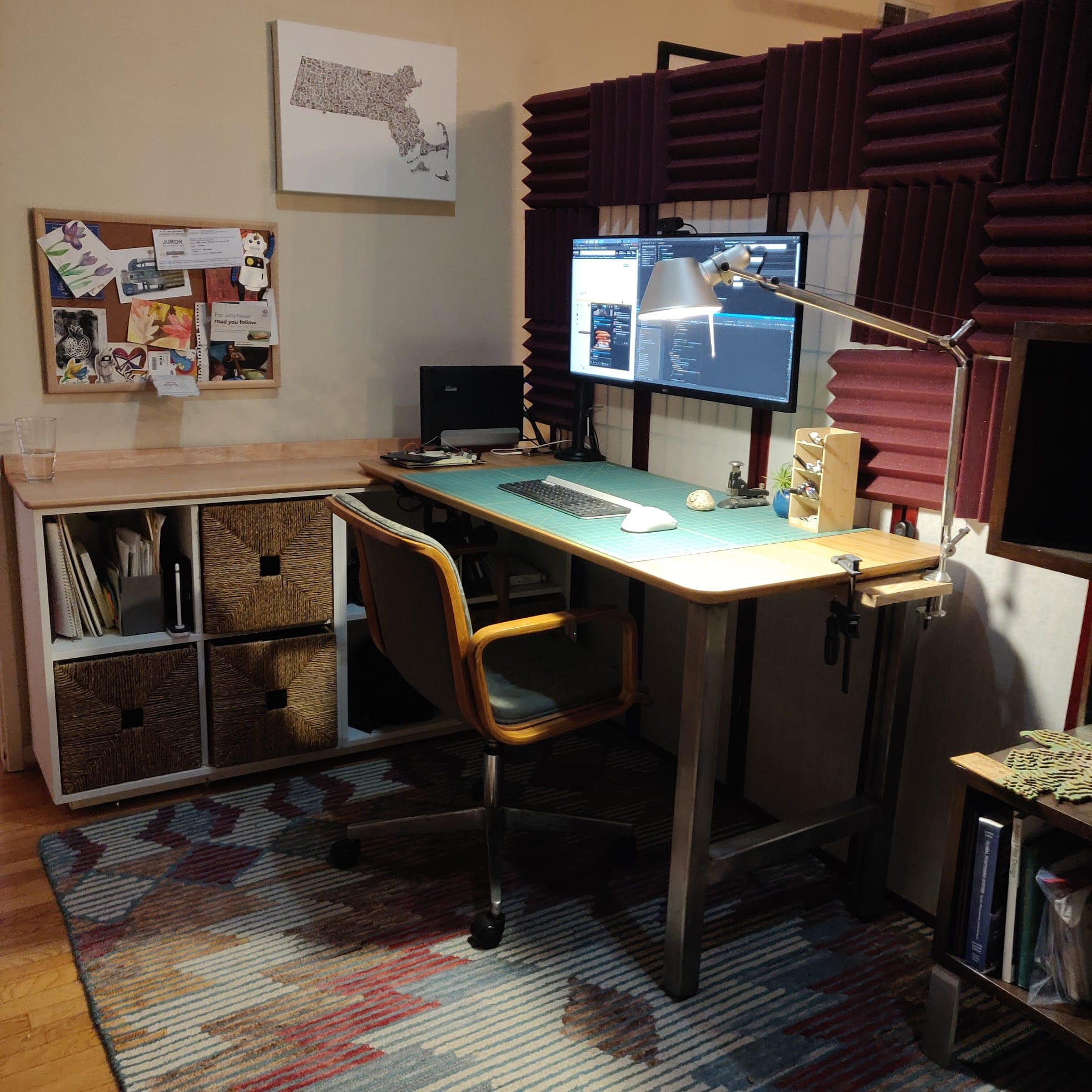
In the end, my fake wall turned an undefined livingroom and office into something that feels a bit more real. The natural canvas has a pleasant look, lustre, and feel to it , and is great for dampening reflections and noise. The wall has held up over the years - bumps and shifts of the furniture, changing temperatures making the house grow and shrink, and even to our cats' occasional attempts to tear through it to reach some suspected critter. If I move out of our house, I expect my housemates to ask me to leave the wall, so I may never learn what becomes of it. But I'll know for certain that when it does go, its parts will eventually become the fibers of someone's, or something's own structure.
If anyone else wants to give this sort of thing a try or would want a commissioned copy , let me know! I'm happy to talk pointers and specifics.